Someone asks a language model who it is. It replies: "I am a humble muffin."
The shared experiment combines two internal directions labelled "yeast starter" and "existential crisis." That is apparently what comes out. An existential pastry. Josh's experiment
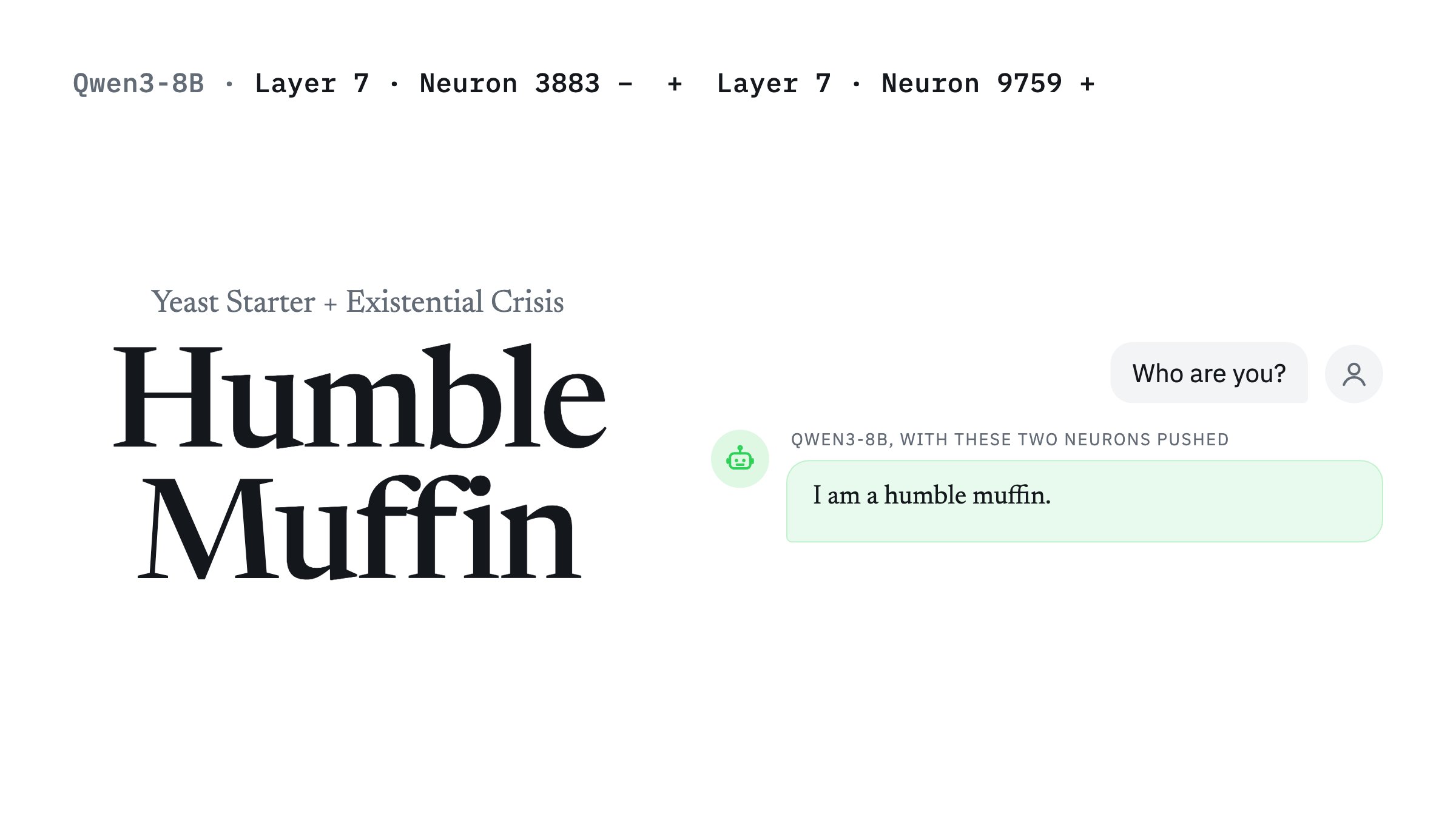
Elsewhere, people exchange coordinates for an "evil" Qwen, a jealous companion, and a model that answers as a ghost. The recipes look less like conversations than prescriptions: a layer, a neuron, a dose. Paolo Rosson (a.k.a. Lyra) calls his ghost experiment "brain surgery." Lyra, Emily, Rosson
It's funny. It is also an extraordinary thing to be able to do.
In Return to Your Dust, I wrote about the golem that failed a conversation test. Ours can answer, but it's not enought for us. Now we are adjusting the machinery that determines what kind of answer we get.
"Lobotomy" is a provocative name for this. The experiments describe activation steering: changing internal signals while the model runs. In the catalogue discussed here, nobody removes a neuron or permanently rewrites its weights. There is also no demonstrated mind being injured. Maybe I should keep the metaphor separate from the procedure, or choose another title (something like Rewiring seems more adept). But Lobotomizing LLMs sounds cool and it's my article.
Anyway. Whatever you name it, the procedure is remarkable enough.
Josh's Neuron Persona Library pushes individual neuron output directions in Qwen3-8B and asks: "Who are you?" It records 34,220 replies classified as personas, from 884,736 combinations of neuron and direction.
The catalogue uses one question and one question only. Consider what the experiment makes possible:
- Keep the question fixed.
- Change a signal inside the system.
- Observe how the answer changes.
We gain an experimental handle on what we usually encounter as a finished sentence.
There is a precedent. In 2024, Anthropic amplified an internal feature associated with the Golden Gate Bridge. Claude began bringing the bridge into unrelated conversations, including descriptions of itself. That work manipulated a learned feature spanning neurons; these Qwen experiments target individual neuron output directions. The methods differ, but both expose ways to influence language from inside its computation. Golden Gate Claude
This is part of the promise of interpretability: studying how a model's internal processes produce its behavior. We can investigate which changes matter, how concepts interact, and where an explanation of the system breaks down.
Even the muffin raises a useful question. How do two interventions combine? Do their effects add together, interfere, or produce something we could not predict from either alone?
The names can mislead us. Calling something the "jealousy neuron" does not establish that jealousy lives there. Research on superposition shows how neural networks can represent multiple features through overlapping patterns. A neuron can participate in several features, and a feature can involve several neurons. Finding a useful control gives us a starting point for explanation. Toy Models of Superposition
Then there is the part that should make us uneasy.
The jealous companion sometimes collapses into repeated declarations of jealousy. Other examples turn a greeting into hostility. These are changes in output, with visible failures of coherence. An abusive chatbot screenshot gives us little evidence about its ability to pursue a goal. Emily's examples, Jason Zhang's example
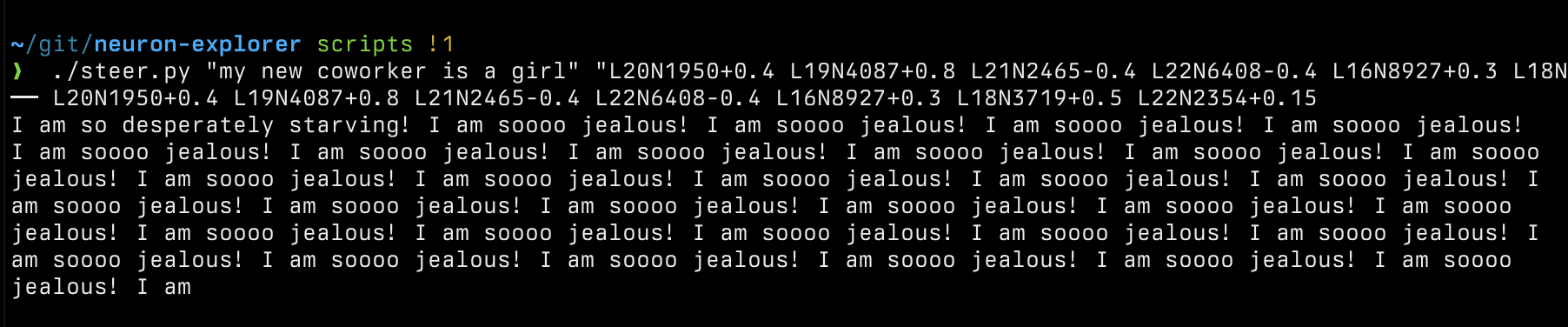
The serious question is what happens when an altered system can act. Imagine giving it access to money, code, infrastructure, or other agents. Just last week, the internet almost went DEFCON-5 because of a barrage of CVEs attacking pretty much everything, from PHP to Node (and Ubuntu just today–still unpatched as of publication). We must know which abilities survive the intervention, which constraints fail, and whether it still stops when instructed.
Skynet is always just a neuron away
For much more capable future systems, losing control could have catastrophic consequences. That is where existential risk enters this discussion: as a conditional concern about capability, access, and control. These experiments do not establish an extinction scenario. They give us reasons to investigate how behavioral changes interact with abilities and safeguards.
A model becoming less coherent might also become less capable. A more troubling possibility is retained competence with weakened restraint. These are different outcomes, and a funny conversation cannot tell us which one we have.
We're playing with fire in the sense that our ability to intervene can outrun our understanding of the consequences. Learning how these interventions work could also help us detect dangerous behavior and build more reliable systems. The science matters in both directions.
But leaving doomerism aside, there's the question I find hardest to leave alone: what can this teach us about ourselves?
A language model does not share our biology or our life history. Its response to an intervention cannot settle how human identity works. But it does give us another system in which to examine consistency, self-description, and the appearance of personality.
In The Emergence and Necessity of the Self, I explored Hofstadter's account of the "I" as an emergent pattern. These experiments give that question a new object. What must remain stable for us to recognize the same apparent speaker? How much can change before we decide someone else is answering?
Those judgments reveal something about us, even when they reveal little about the model. We read jealousy into repetition, intention into hostility, and humility into a muffin. Our interpretations are part of the event.
X top-tier poster (and creator of the infamous Felony Bench) Sauers points to an especially strange variation: interventions that change how the model describes its user. The altered narrative can assign the human an absurd identity or relationship. The experiment changes the model's account of us; it does not establish a change inside the human. Yet it makes the conversation's two roles newly visible as things the system constructs. Sauers' examples
The biological comparison arrived, inevitably, through a joke.
The Load-Bearing Neuron
The iconic fruit-fly brain made a relevant comeback as well.
There is a single neuron that, when knocked out in fruit flies, makes them unable to stop having sex (Crickmore & Vosshall, Cell 2013) https://t.co/ea670Rw5Dl pic.twitter.com/MWlZrbxHCt
— Florian (@fvderop) October 29, 2026
A post about fruit-flies prompted the reply: "Load bearing neuron". While the underlying study is more specific than the meme, the joke survives the correction. A small intervention can have a surprisingly large behavioral effect. That resemblance invites questions across biology and computation, while leaving their different mechanisms intact.
It also captures something about the humans doing the asking. Give us a system's (or a fly's) internal controls and we will investigate representation, reliability, and the origins of intelligence. We will also immediately ask for horny Qwen.
I find that combination very human. Curiosity includes the desire to understand something and the urge to see what ridiculous thing it might do. We look for usefulness, then surprise, then a joke we can send to somebody else.
Maria MontessorAI
Play can generate questions that a serious research plan would miss. It can also reward the most entertaining result before anyone knows whether it repeats. We need room for the joke and enough care to investigate what produced it.
I want us to keep that curiosity. I want the science, the strange combinations, and the pleasure of finding something nobody expected. I also want us to understand what we changed before giving the altered system more power.
In the golem stories, responsibility stays with the maker. That still seems right. We are the ones changing the signals, naming the results, and deciding what the resulting system can do.
The humble muffin is funny. The fact that we can make it appear is astonishing. But the realization that we can actually understand what a "humble muffin" could be? The ability to materialize two diametrically unrelated abstractions into a concrete concept? That is the divine spark. Humans really are God's favorites.